
‘Weaponising Anti-Semitism: How The Israel Lobby Brought Down Jeremy Corbyn’ by Asa Winstanley reviewed by Larry O’Hara OR Books £13.29 (published in Labour Briefing March 2024)
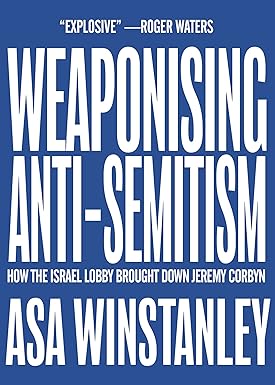
A superb and timely book, although I would prefer that it had been called ‘Weaponising Accusations of Anti-Semitism’. Winstanley, a (former) party member, meticulously explores the roots and branches of Labour’s so-called anti-Semitism crisis, and how the Labour Right, both before Starmer and currently, have weaponised it. As somebody who does research myself, I was very impressed by his fantastic range of sources. Many items in this (dense) book have previously appeared in the excellent Electronic Intifada.
This book greatly adds to the historical record, correcting misinformation in books by Owen Jones and Patrick Maguire/Gabriel Pogrund. Every high-profile episode in the witch-hunt against Labour’s Left is there: starting with the false allegations against Max Shanly and Oxford University Corbyn-supporters (p.72-79/92-94). I did not realise this episode’s significance at the time, but Winstanley did.
Other political lynchings: of MP Naz Shah (p.159-63), Jackie Walker, Naomi Wimborne-Idrissi (p.195-201/270) for instance, are included also. The book gets depressing: chronicling the Labour Right’s sheer no-holds barred mendacity, for example (then) MP Joan Ryan inventing an anti-Semitic exchange (p.113-116), or under-threat MP Louise Ellman getting her whole local (Liverpool Riverside) Labour Party put into ‘special measures’ to prevent her deselection (211-217).
While chronicling myriad injustices is important, Winstanley also utilises the landmark 2017 Al Jazeera documentary ‘The Lobby’, when an undercover reporter recorded the true relationships between Labour Party elements, certain domestic Jewish organisations and the Israeli state including the Embassy and sinister ‘Ministry of Strategic Affairs’ (31-3/121-3). He shows beyond doubt that the Jewish Labour Movement, key in witch-hunting Leftists, many of them Jewish, were a hollow shell before Corbyn became leader in 2015. Their resuscitation had one over-riding aim: removing Jeremy Corbyn. Now, absurdly, they oversee ‘educating’ Party members about anti-Semitism! Utterly shameful. Key employee Ella Rose (now a Labour councillor) was put in post by the Embassy (p.117/124/146). ‘Labour Friends of Israel’ (LFI) are no better, according to current Director Michael Rubin (recorded undercover) “publicly we just try to keep LFI as a separate identity to the Israel Embassy because being LFI allows us to reach out to people who wouldn’t want to get involved with the embassy” (p.107). You couldn’t find a better definition of front group (see p.120)! Winstanley is not afraid to name names, none have sued because everything he says is true.
He also sets the historical record straight, not just on the Israeli Labour Party (who invaded the West Bank when in government), but the anti-Semitic politics of Ramsay McDonald, Hugh Dalton and others. This did not preclude them supporting Zionism, including the infamous 1944 Labour NEC Report recommending expelling Arabs from Palestine (p.52). Winstanley makes an error, in my view: while correctly absolving Ken Livingstone of anti-Semitism, they are both wrong reiterating at face-value Livingstone’s remark Hitler was “supporting Zionism before he went mad and killed 6 million Jews” (p.139). Having studied Hitler, I assure you his Jew-hatred was ingrained, undoubted Nazi dealings with Zionists Nazis were not support but merely one superceded way of solving the ‘Jewish problem’, explaining too SS luminary Heydrich’s 1935 “agreement” with Zionism (p.153). As Winstanley later comments, just a precursor to the ‘Final Solution’.
Some you might expect better of (e.g. Momentum’s John Lansman) are slammed (p.91-2/201-6) and too, Jeremy Corbyn, essentially too nice to mortal enemies, exemplified by dealings with the LFI “treating a deadly enemy as if it were a friend”. Yet keeping his distance not just from Jewish Voice for Labour (p.270-71) but standing by while supportive colleagues such as Marc Wadsworth (p.193), Chris Williamson (p.255-60) and above all Livingstone (p.159) were shoved under the bus. Winstanley thinks the response should have been a political and legal counter-offensive, suing the likes of Margaret Hodge when she repeated vile slurs in the Guardian. I agree. Another chilling thought: then Israeli Ambassador Mark Regev is important throughout (p.280-4/99-101). Described as having the “ability to hold the line when there is bad publicity” (p.99). Current job? Israeli PM Netanyahu’s spokesman getting deferentially treated on the airwaves daily denying genocide in Gaza. Buy this book: and learn the lessons for next time.
About The Author
