
Mike Phipps ‘Don’t Stop Thinking About Tomorrow: Labour After Jeremy Corbyn’ OR Books £20.62 2022 (first published in Labour Briefing October 2022)
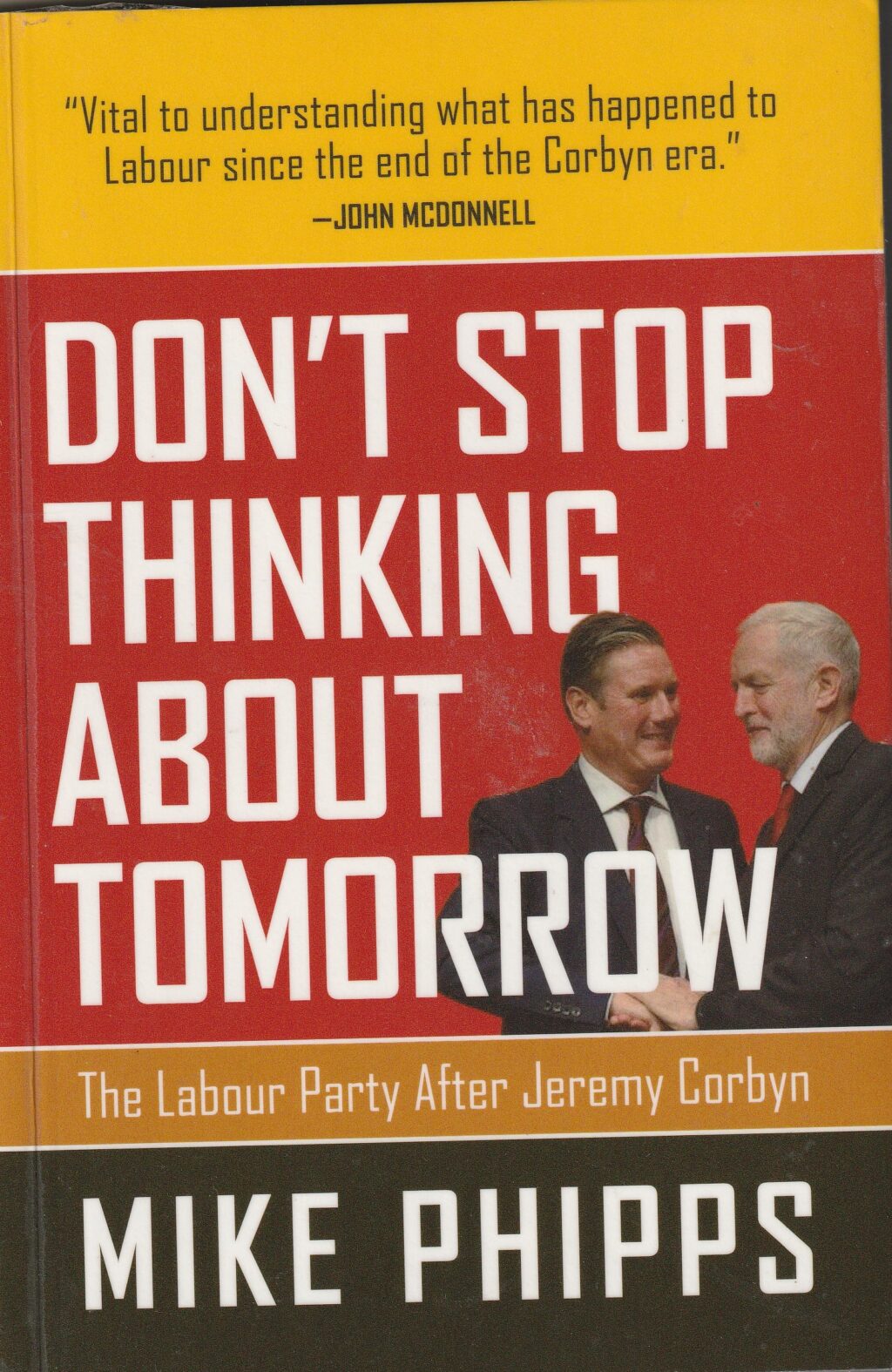
Reviewed by Larry O’Hara
This welcome book is a sober (but necessary) follow-up to Phipps previous book, ‘For The Many’, which in 2017 explored a possible Left Labour Government programme. That again seems a distant possibility, and there is sadly enough detail here concerning the Starmer regime’s attempts to expel members and junk radical policies to make any Leftists who voted for him in 2020 weep.
Discussing the 2019 Election defeat, Phipps advances various reasons: some, such as the lack of coherently linked explained policies, or a poor digital campaign (p.51-56) are uncontroversial. Others, such as the leadership’s line on Brexit (an event Phipps clearly dislikes: see p.44-5/62), are debatable, and using Paul Mason as a sage here, given recent revelations regarding his state connections, looks even more misguided than at first sight. Even more debatable is criticising Jeremy Corbyn for not taking the anti-Semitism issue within Labour seriously enough (p.40/85/87). The various leaks/Forde Report on the contrary show it was taken very seriously indeed. Phipps does cut to the chase concerning 2019—“Labour’s 2017 result, just eighteen months earlier, was the best in vote share of the last five general elections. The question must then be: what changed over the subsequent two and a half years? Those on the Labour right who began attacking Corbyn from the moment he became leader in 2015 cannot answer this critical question. Moreover, many have lost the moral authority to do so” (p.36). Quite.
Phipps chronicles well how Starmer has stifled dissent, and the 2021 Labour Conference a ruthlessly stage-managed event (p.13-18/190-2). He also pinpoints the vacuity of Starmer’s political ‘vision’ (p.21-24), and has a most passable account of Starmer’s first year in office (Chapter 2). At this point it becomes clear that (bravely) this book is no demolition of Starmer (Oliver Eagleton has achieved that) but proffers an olive branch to Labour members (in the Centre?) prepared to give Starmer a chance (p.183): based on the premise that the “Right of the Party really didn’t want him” (p.26). Not writing off Starmer explains an utterly fanciful suggestion: that the whip be restored to Corbyn and his campaigning skills be used (p.94). Phipps suggests that “for Starmer to do this would require him to confront the Party’s intractable Right wing” (p.185). As unlikely as an ice-cream franchise in hell: and, unlike Kinnock, Starmer (youthful dalliance aside) has never had Leftist roots.
Phipps rightly points out it is the Labour Left who currently have the policy ideas (p.10-11/124). As he puts it, “the Left’s increasing intellectual strength, alongside its ability to win policy in the elected bodies of the Party, means that senior Labour figures also feel the pressure to borrow its ideas if they are to mount a serious political challenge to the government” (p.126). While true of (born again) Ed Miliband, this is no way applicable to Shadow Chancellor Rachel Reeves, who Phipps concedes is “firmly on the Right of the Party” (p.107). Indeed, I am not at all sure that, as Phipps puts it, it is too “conspiratorial” to suggest the Right want to drive the Left out of the Party (p.76).
Phipps is on stronger ground outlining some excellent work by Labour locally, including ‘Platform Municipalism’ (p.143-51). He also, commendably, tackles the issue of how the Left should speak of/come to terms with, patriotism and what the military should be for (p.138-48). Equally acutely, this whole book raises the question of what Labour is and should be for, a conundrum to which, even on the Left, there is no agreed answer. Phipps frames it thus–“as an electoralist party, Labour offers a retail package which voters can buy into, rather than mass empowerment. Perhaps the latter is needed for a socialist transformation” (p.63). I would suggest there is no ‘perhaps’ about it, and while continuing radical policy development (and extra-parliamentary struggle) is vital, the prospect of the Left crouching in the corner trying to lob diluted policy crumbs onto the various Shadow Cabinet plates is an intriguing but ultimately futile prospect….
About The Author
